- The Yarrow Letter
- Posts
- Building Self Esteem - The Foundation Of Self-Development
Building Self Esteem - The Foundation Of Self-Development
These six practices are non-negotiable for your growth.

Yarrow Achillea
September 24, 2023
The Yarrow Letter
September 24, 2023
Welcome friends. Today’s letter is a long one. To read the full letter click the link to read online at the top of this email.
The average lifespan in the U.S.A. is 77 years.
-I have about 3000~ weeks left in my life. I’m going to make the best of them.
My mission is to live “the good life”. How do we live with no regrets? What kind of life is one I can be proud of? My search for these answers has led me to the creation of this newsletter. Let’s dig into this good life journey - together.
Self-esteem has long been an interest to me. I’ve found myself wondering how successful people make it. How are they so confident?
I nominate the 6 life practices involved with building self-esteem.
This letter will outline those practices.
Self-esteem is the first foundational life pillar one should understand in their journey to self-actualization.
With self-esteem, the tallest mountains become like molehills to us.
But problems don’t get easier with self-esteem, we get better.
Just like those cringe mobile ads with a knight character failing at basic math, we cannot surpass a level 8 problem while we are a level 3 human. We need to build ourselves up (smashing lower-level problems and picking up skills) until we are level 9, then we can manage that problem.
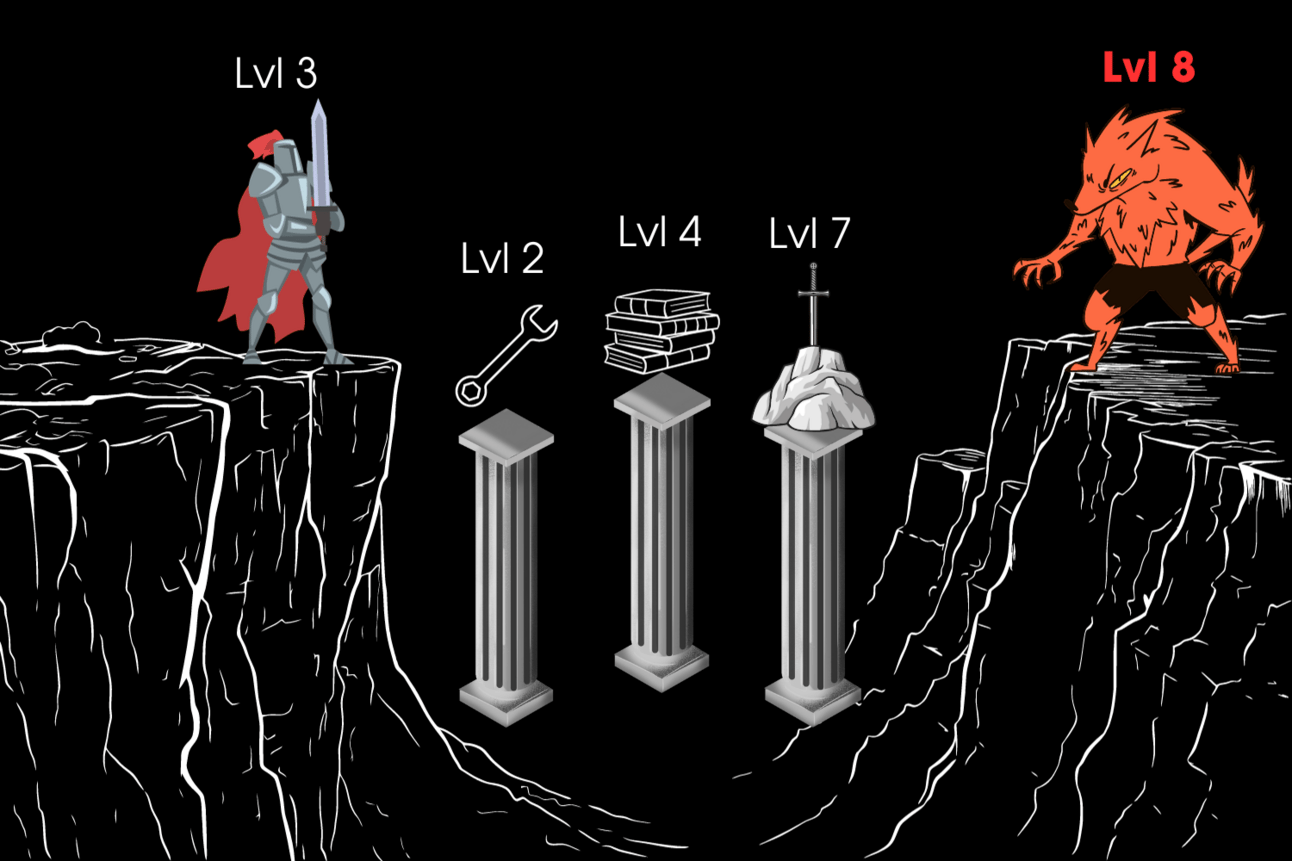
To graciously handle the level 8 challenge of college (the werewolf) our level 3 hero will:
Delete some bad habits from their life, and optimize their lifestyle. (lvl 2 quest)
Learn a useful new skill: stress management, effective notetaking, etc. (lvl 4 quest)
Obtain a new tool, E-bike, a laptop, or a car to expedite daily tasks. (lvl 7 quest)
With all this new personal power, combined with the practices of self-esteem, our hero will slay the beast and get the degree.
Of course, the way we build ourselves will differ dramatically. Don’t take this as a serious guide to college.
Apply yourself to the practices of self-esteem and never hit rock bottom again.
And most importantly:
Do not let your understanding of self-esteem remain vague.
What is self-esteem?
Self-esteem is NOT telling yourself affirmations in the mirror. Self-esteem is the product of your actions, it is earned.
Whether your self-esteem is unhealthy or healthy it will act as a machine that produces more of what you put in it.
Self-esteem has a reciprocal relationship with its causes and effects.
Your rate of return is determined by your consistency.
Self-esteem:
- Cannot be given to you - it is not the feeling of being loved by others.
- Is present with or without your acknowledgment.
- Is not low-hanging fruit - waiting for you to claim it.
- Is built on your actions.
Consider the effects of these actions on your self-esteem:
- Focusing versus TikTok/Instagram scrolling.
- Clarity versus vagueness.
- Perseverance in effort to learn versus abandonment of effort.
- Self-confrontation versus self-avoidance.
A healthy self-esteem is the knowing that life is meant for us, and we are meant to live. We must also know that we are capable of facing the challenges and requirements of life.
This is broken into:
Self-efficacy - confidence in our processes to handle the challenges of life. This is deeper than our confidence in our specific skills and knowledge, it is trust in our capability to think, act, and learn.
Self-respect - confidence in our claim to success, happiness, needs, wants, and worthiness. This is not the delusion that we are perfect or superior to others - it isn't competitive - it is the conviction of our value.
Healthy self-esteem is a need - as it is a foundational component of the life process.
Persons of high self-esteem take joy in being who they are. Joy is their influence, not fear. They pursue what they want, instead of running from what they don't want.
Signs of healthy self-esteem:
Rationality
Realism
Intuitiveness
Creativity
Independence
Flexibility
Ability to manage change
Willingness to admit (and correct) mistakes
Benevolence
Cooperativeness.
Effects of low self-esteem:
Aimlessness
A sense that we are powerless in the face of challenge
Getting overwhelmed at the thought of life
Sentence-completion method.
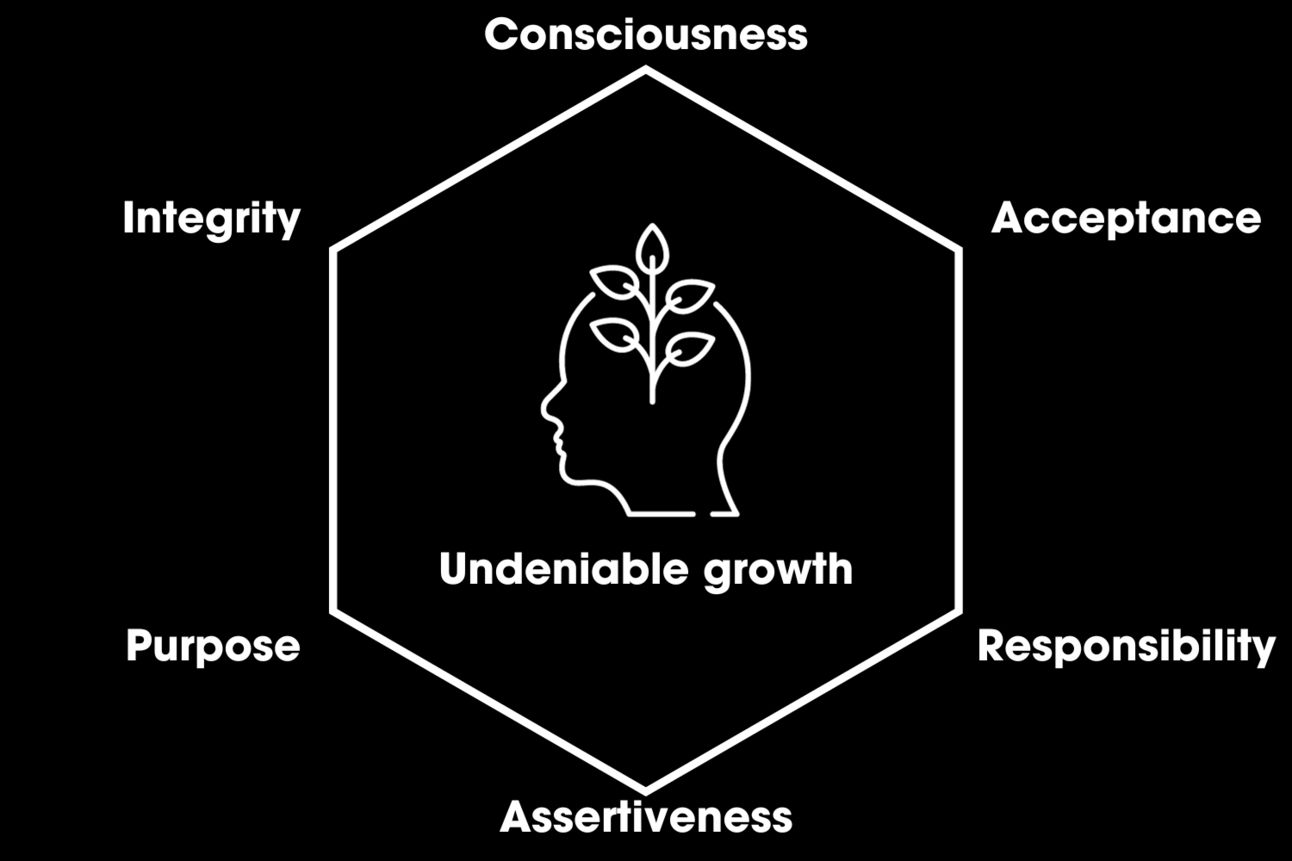
The Six Pillars Of Self-Esteem is a set of practices to build and maintain healthy self-esteem - developed by Canadian-American Psychotherapist Nathaniel Branden. I'll describe Branden’s six pillars shortly.
We can bring more awareness to all of these practices by using the sentence-completion method.
Example:
Living consciously to me means—
If I pay more attention to how I deal with people today—
Each morning you will complete a few sentence stems.
The goal is to write at least 6 different endings for the stem as fast as possible. Do not pause for reflection. Do this for 2-3 minutes.
It only has to make sense grammatically - your finished sentence does not need to be true, reasonable, or significant - any ending is fine.
After completing one sentence stem move on to the next and so on, when you're done go on with your day's business.
In the evening you will complete reflective versions of the morning stems:
When I reflect on how I would feel if I lived more consciously—
When I reflect on what happens when I bring 5 percent more awareness to my activities—
Again write 6-10 endings for each stem.
Do this routine every weekday or 5 days a week. Do not read your previous day's work. Repetition is inevitable, sometimes new endings will be created. Each weekend reread what you have written, then write a minimum of 6 endings for this stem:
If any of what I wrote this week is true, it would be helpful if I—
For this weekend stem it is ideal to write with an empty mind, don't impose any expectations or demands of the situation. One of these sessions should not last more than 10 minutes, else you'd be thinking too much.
This method energizes your psyche to work for you, it will be impossible to go throughout your days without considering what you have been writing. If your stems are about consciousness then you will begin to see changes in your conscious approach to life.

Stems provided by Nathaniel Branden’s book: The Six Pillars Of Self-Esteem: The Definitive Work on Self-Esteem by the Leading Pioneer in the Field.
Now, the six pillars:
1. The practice of living consciously
Most people are going through this existence with their mind’s eye closed. They sleepwalk through life, and they live by a reality that was constructed by others.
Enlightenment is akin to waking up. The expansion of consciousness is the catalyst for evolution and progress.
Consciousness or awareness of reality is an essential tool for survival.
It is the ability to be aware of the environment and guide action accordingly.
The mind: the unique human form of consciousness, capable of abstract thought and concept information.
The use of consciousness is not automatic, it is a choice. You alone are responsible for living consciously.
You can focus your mind or choose not to - defy your basic tool of survival and your self-esteem will suffer.
We cannot feel competent while going through life in a mental fog.
Deep in our psyche the choices ~between confronting reality and avoiding it~ add up.
- The sum of this experience is our self-esteem.
Consciousness is more than seeing and knowing - it is acting on what you know.
To procrastinate this action is to invalidate your mind and build distrust in yourself.
Self-esteem is the reputation we build with ourselves.
Living consciously looks like:
A mind that is active rather than passive.
-The choice to think and seek awareness, knowledge, and understanding. We are responsible for our existence and happiness. No one can relieve us of the necessity of thought.
An intelligence that takes joy in its function.
-Consciousness should not be a burden, this may take some time, but for those who commit to living consciousness learning and awareness will be joyful.
Being “in the moment,” without losing the wider context.
-To be doing what you are doing while not being trapped in the moment.
Reaching out toward relevant facts rather than withdrawing from them.
-Continuing to be curious about new information that may develop your understanding.
Being concerned with distinguishing facts from interpretations and emotions.
-Our inner voice is not the ultimate road to truth.
These are three different questions, don’t lump them up:
What we perceiveWhat we interpret it to mean
How we feel about itThe lack of distinguishment in these results in an ungrounded sense of reality.
Noticing and confronting my impulses to avoid or deny painful or threatening realities.
-Fear and pain should not be signals to close our eyes, but to widen them and look more attentively.
Many distractions of the modern day pull us into unconsciousness.
To name a few:
-Tiktok and other short-form content scrolling
-Most video games, especially when played excessively
-TV, when not educational
Being concerned with knowing “where I am” relative to my various (personal and professional) goals and projects, and whether I am succeeding or failing.
-Do you have an action plan or are you just hoping things will improve?
Being concerned to know if my actions are in alignment with my purposes.
Searching for feedback from the environment to adjust or correct my course when necessary.
-In our effort towards our goals we cannot make one rigid plan and expect success. Change is a constant of our reality and we must be prepared to course-correct.
Persevering in the attempt to understand despite difficulties.
-Giving up should never be your first reaction to challenge. You are capable of so much. It only takes consistent effort for you to start believing that too.
If you come across a stubborn problem - take a break, ask around, and come back to it later. The choice to discontinue your effort should be a conscious and informed one.
Being receptive to new knowledge and willing to reexamine old assumptions.
-If our current knowledge IS correct, new clarifications and improvements in our understanding are always possible.
Know that there is what you do not know.
Being willing to see and correct mistakes.
-A conscious being lives by rationality, therefore loyal to truth instead of "being right". If we associate self-esteem with being perfect or above error we are forcing ourselves to shrink the consciousness in misguided self-protection.
Seeking always to expand awareness—a commitment to learning—therefore, a commitment to growth as a way of life.
-Those who resign themselves to having "learned enough" are on a downward trajectory of consciousness.
A concern to understand the world around me.
-The world, mother nature, and society affect our:
Health - physical environment
Attitudes and values - culture
Standard of living - Economy
Freedom - Politics
-Ask yourself:
Do I notice when my feelings and actions are coincident?
Do I know what I want out of a particular encounter? (not what I think I "should" want”
Do I know what I want my life trajectory to be?
Do I know what I am doing when I like myself and what I'm doing when I don't?
This is not about constant self-introspection - this is the art of noticing.
-Notice the feelings in your body.
-Notice the emotional reaction you have to different people.
-Notice whether the voice in your head is your own or another.
Why notice our behavioral patterns? So we can see which actions produce results.
A concern to be aware of the values that move and guide me, as well as their roots, so that I am not ruled by values I have irrationally adopted or uncritically accepted from others.
-Values that we grow into aren't always supportive of our true interests.
-We are not limited to the labels we put ourselves into.
Consciousness and the body
Austrian doctor and psychoanalyst Wilhelm Reich found that emotions - when blocked and repressed, affect the body.
Muscles are contracted and breathing is restricted. If this goes on the result is an obstruction of feeling and awareness.
Physical therapists work to open up the breathing and muscle contractions, this is known as "rolfing". Successful patients regain feeling and clarity.
Freeing the body can free the mind and vice versa.
Patients who make the conscious effort to feel their body and emotions during this process gain much more than when closing themselves off to the experience.
2. The practice of self-acceptance

"Self-acceptance is the refusal to be in an adversarial relationship to myself." - Nathaniel Branden
Branden describes this pillar as the most misunderstood.
Observation: If you do not love yourself, you will be unable to love others and you will find it difficult to believe others could love you.
Keys to self-acceptance:
-It is selfishness in the noblest form.
- It is valuing, respecting, and standing up for your existence. This instinctive force within us can be disintegrated by self-rejection.
-It is to accept that which we think, desire, do, and are. It is the willingness to experience the facts of our being at any moment.
-To accept is more than acknowledging or admitting, it is to fully absorb and contemplate the reality of your existence.
-Accepting does not mean liking or approving.
-It is not indifference to growth and change.
-Self-acceptance is the precondition for change and growth.
-Accepting our feelings does not empower them to have the final say in what we do. Negative feelings, when fully accepted and felt, can be let go easier.
-If we disown our true emotions we are driven to lash out with anger or become overwhelmed with anxiety.
-We can only forgive ourselves for the things we have first accepted.
-Self-acceptance is trying to understand yourself as you would try to understand a best friend. A good friend might say "What made you decide to take that action?”
Self-rejection looks like:
-Rejection is saying: this is not me, this is not mine.
-Anything you experience, we can disown.
-We can disown our assets and shortcomings.
Assets offer the challenge of responsibility.
Liabilities confront us with inadequacy.
-It keeps us passive to the things that control us.
Substances, society, bad habits, bad relationships, poor ethics and values.
-Rejection of a fact of our life keeps us from changing or growing in that area. A smoker might say, "I can quit anytime, I'm confident that I can quit so I'll just do it later."
When is later? Here's one of my favorite phrases about change and growth:
One day or day one?
When self-acceptance feels impossible
Imagine having a thought, feeling, or memory so distressing that accepting it feels impossible. We feel we can only block and suppress this feeling.
Instead of resisting our resistance, we have to first accept that we are resisting.
Resistance to the self-experience will dissolve with acceptance.
An emotional block survives only with continued opposition.
3. The practice of self-responsibility
"To feel competent to live and worthy of happiness, I need to experience a sense of control over my existence. This requires that I be willing to take responsibility for my actions and the attainment of my goals." - Nathaniel Branden
Self-responsibility means:
-I am responsible for achieving my goals.
-No one owes me the fulfillment of my wishes.
-I am responsible for my choices and actions.
-Owning that I am the main source of my choices and actions.
-I am responsible for the level of consciousness I bring to my work, relationships, values, communications, and how I spend my time.
-A high level of consciousness is maintained when I take responsibility for my life.
-I am responsible for how I prioritize my time.
-I am responsible for my happiness.
-Placing my happiness in my own hands sets me free.
-I am responsible for raising my self-esteem.
-We are meant to grow from dependent children to self-supporting adults, psychologically and financially.
-Self-responsibility is expressed as an active orientation to life.
Who is ultimately responsible for the quality of your life?
If you answer anything besides "myself" you are thinking with a victim mindset.
Self-responsible people will respond to a problem with "What can I do about it? What actions are possible? What did I overlook?" And so on.
They do not protest with:
"But no one told me what to do! But it's not my job! I can't do that!"
The self-responsible are solution-oriented.
A Personal Example
I recently failed to act on my self-responsibility. I saw that the relationship I was in was not in line with my lifestyle. Instead of trying to bring up the issue, I withheld. Not wanting to be the "bad guy" I quietly, and painfully contemplated the state of the relationship.
By the time we parted ways I had still not brought up this turmoil.
I delayed facing the reality that nothing would change unless I acted.
I failed like many others have. One partner might notice the mismatch first, but they are unwilling to bring it up. This leads to a hurtful situation for both until they end things.
My responsibility was to act on my observations.
Knowledge
We learn from other people, but knowledge is built on understanding. Memorization, repetition, and imitation will not pass as knowledge.
It is our responsibility to exercise our own minds and think for ourselves. The alternative is to accept others’ evaluations - uncritically.
Thinking is not recycling the opinions of others.
If you are wise you will be wary of self-deception. Don’t let your inner talk create false narratives and excuses.
Responsibility and philosophy
Taking responsibility for our existence is to affirm that others are not servants and do not exist to facilitate our needs.
This claim implies a rule for our relationships:
Never ask a person to act against their self-interest.
No one is coming
No one is coming to save you.
No one is coming to solve your problems.
If you don't do something, nothing will get better.
No amount of silent, actionless suffering will summon a miracle unto you.
You could say that I came. But I have come to tell you that no one is coming.
Taking 100% Responsibility:
This means responsibility for things you have no control over.
Personal responsibility does not mean taking the blame or the fault. This is all about how you take action in the present moment.
6 areas to start taking full responsibility in:
1. Success, it's easy to take responsibility for success. If you got a promotion you might easily say: Yeah I worked hard for that.
2. Failures. In all areas of life. When you are failing to obtain your desired results. Blaming others or circumstances for your failures is the alternative to responsibility.
3. Emotions are not caused by external things in life, like people or events. They are your internal reactions, and they are generated by yourself. I will write more about emotions soon.
Taking ownership of your emotional reactions to things is to guide your thought process. If you choose to think about an event in a positive way - your emotions will follow. Choose negative thoughts and feel negative emotions.
Thoughts drive emotions. Emotions drive action. Action generates new thoughts.
Which cycle would should we be in? Positive or negative?
Some say "But my negative emotions are a natural reaction to this event".
To that I reply: if the natural option is depressing and unhelpful - I'll look for another way.
4. Accidents. Take responsibility for things that are out of your control. This is not taking the blame. Take responsibility for the actions and reactions you have.
If you are sitting at a red light in your car, and you get rear-ended, you must take responsibility for that.
Here's a thought experiment about driving:
As an active participant on roadways, you are agreeing to a silent contract that outlines the possibility of reckless or unfit drivers.
Take responsibility for your participation in the system that has the chance of producing these outcomes.
5. Circumstances of your life. The family you were born into, the country you were born in. Your genetics. The money you have now. The political system in your country.
This is not to say you are at fault for your circumstances. You are responsible for how you live with your circumstances, and what you make of them.
6. Relationships. You are responsible for the dynamic in every relationship you are in. It is easy for us to blame the other for their behavior in the relationship.
Responsibility and stoicism have something in common. The emphasis that you are only in control of one thing - the mind.
-Levels of consciousness and responsibility.
Consider these levels of consciousness.
The victim, the soldier, and the creator.
The difference between these three is the amount of personal responsibility and consciousness applied to the individual's life.
There are of course many other stages among the spectrum of consciousness and responsibility, for brevity I'll focus on these three.
A victim is someone who believes the world is a greater challenge than they are to themselves. They believe they have little or no control in life, and this belief is often an unconscious one.
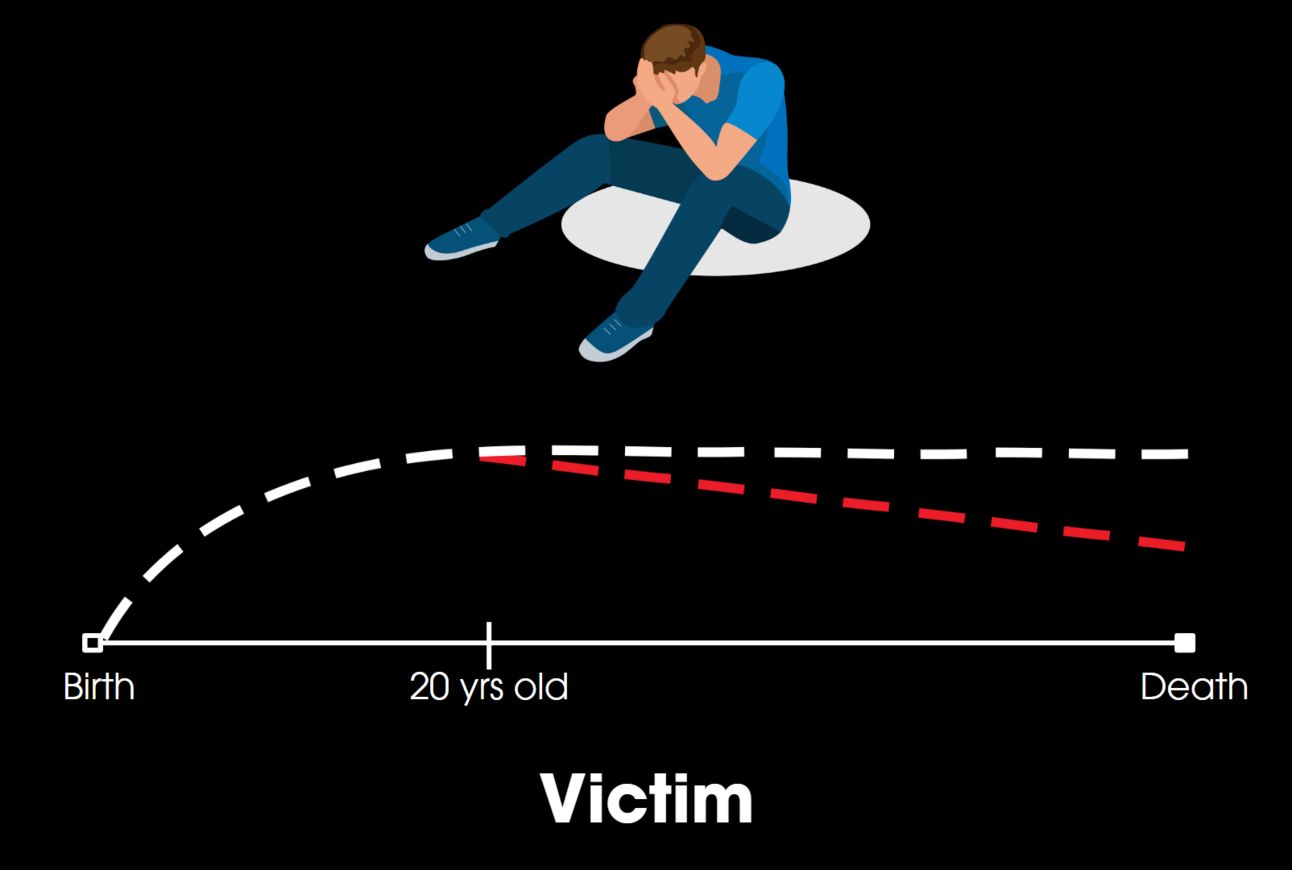
Here is a model of a life stuck in an intense victim mindset. The curve represents personal-development. A victim might experience some natural growth while going through school, but after 20 their growth plateaus, or even decays.
A victim mindset can take hold in any area of your life.
Things a victim will say to themselves:
-It’s not worth it
-I can't
-It's impossible
-It's too hard
-Life is unfair
-I don't know how to do that
-What if I fail
-It's this person's fault!
-I've already tried that
-I always fail, I never get good luck, I never get a break
-I'll try
-Maybe I'll set a goal, maybe
-I'm not good enough
-But there's no point in all this hard work
-It's too much effort
You can give a victim advice and while they might agree with you, they won't make a change in their life. They are too used to their narratives, blaming, complaints, and excuses for that advice to stick with them.
What victims need is to take on massive change.
Our brains are really good at coming up with excuses. You think you made meaningful action and tell yourself:
"I did a lot of hard work, but I don't see any change, this must be the way my life has to go."
If this is the way you think about your actions and outcomes, then you aren’t aware of how much action is needed - and for how long. Massive change doesn’t come easy.
The soldier believes they have more control over their lives compared to a victim. However, they believe that to obtain success they have to take it from another.

While soldiers have a better chance of avoiding a plateau in personal development, their growth will seemingly come with enormous, painful effort.
This type is very competitive, and combative, they easily become angry and frustrated.
They believe they have to work their lives away to succeed.
This is better than a victim mindset because here at least some faith is placed in their control over their life.
A soldier mindset might even lead to ideas about success like:
“Success isn’t meant for everyone”
“I’m not one of the lucky ones”
Or they might even think that it is selfish to pursue success, wealth, and happiness. This is dangerous for self-development because it introduces a filter of guilt upon your achievements.
For the creator, life is what they make it. They have confidence in their self-efficacy - any problem can be worked around, dissolved, or lived with.
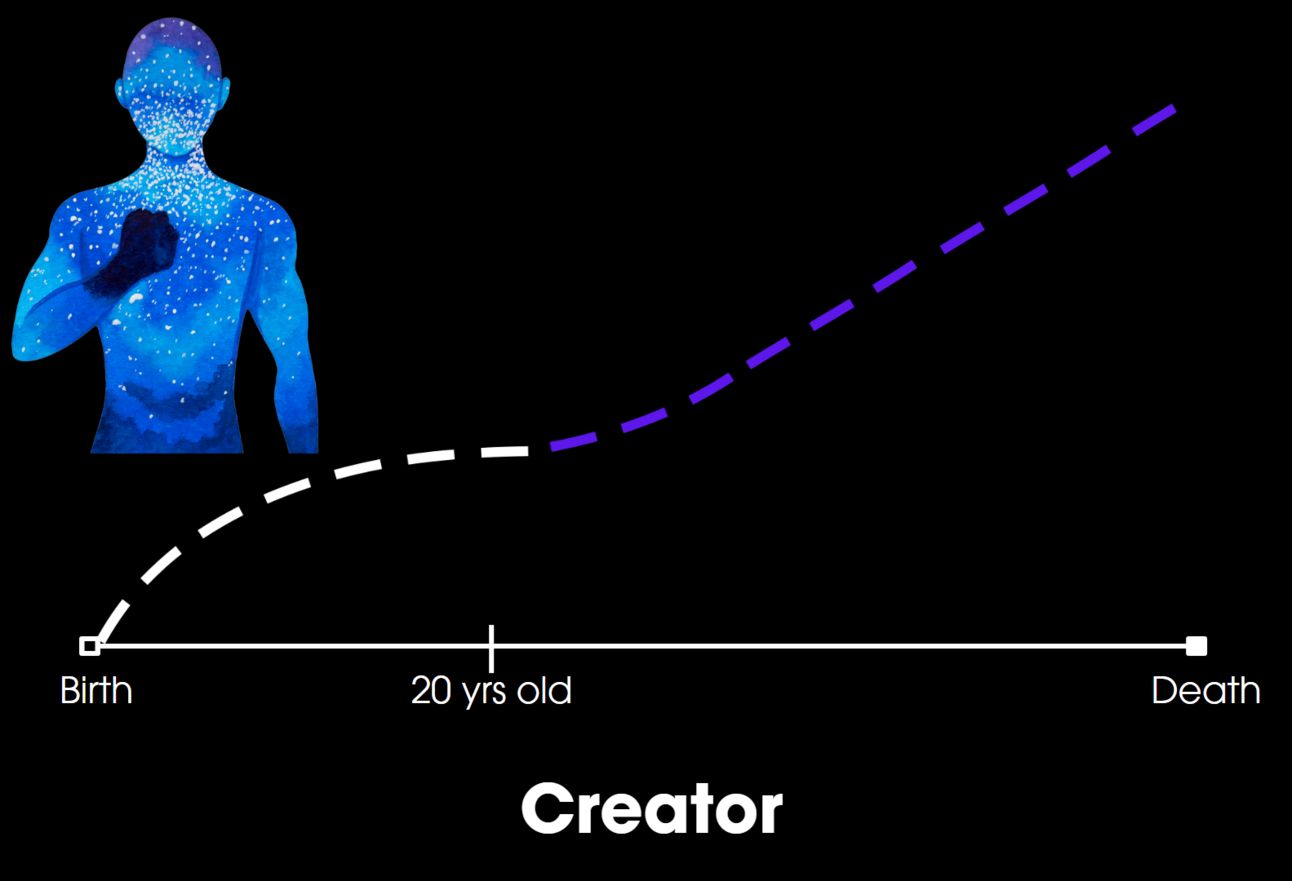
When one becomes a creator in life they will see dramatic personal development, so long as they maintain their personal-responsibility and consciousness.
The creator is focused on what they put out into the world, what they create with their situation. They leave the competitive mindset behind.
A creator is made when a massive personal responsibility is adopted in one's life.
The result of taking more personal responsibility is a higher state of consciousness.
I have seen the light of this path, and I live every day consciously adapting so I can think like the creator. If you haven’t read my journey of self-esteem letter, you can find that here.
4. The practice of self-assertiveness

The precursor to self-assertiveness is consciousness and self-responsibility. Those pillars outline the selection of your thoughts while self-assertion is your conviction and poise for your thoughts in a social context.
Self-assertiveness is a matter of honoring our wants, needs, and values while seeking appropriate forms of expression in reality.
To practice this is to live authentically, or to "be real".
It's important to assert oneself according to the context.
Honoring your truth isn't always necessary during a staff meeting. Respecting this is to be reality-oriented.
To disown your authentic self when the time is appropriate for you to express yourself - self-assertiveness is diminished.
Self-assertiveness can look like:
-Letting someone know you find their jokes tasteless and offensive
-A polite communication of disagreement
-Offering your idea to a group, friend, family member, or team
A well realized individual has a developed sense of self or autonomy, and the capacity for human connectedness.
4 keys to self-assertiveness:
1. Assertion of consciousness
To think, and to hold the outer and inner world within view.
To think for yourself and stand by what you think.
This is not mindless combative or rebellious challenges to others’ thoughts. This is not conscious, and self-assertiveness without consciousness is just drunk-driving your mind.
Healthy self-assertiveness includes the ability to say no.
It is truly tested by what we are for. To live and express our values.
2. To be committed to and responsible for the right to exist.
Practice personal dignity.
This means we cannot look to authority figures to provide protection, like parents or the government.
Instead, generating your own sense of security.
It is important to reflect on if you were raised to treat this like selfishness. To practice self-assertiveness requires conviction in your ideas, wants, and needs.
3. Participating over spectating
Fight for your ideas and bring them into reality.
If you refuse to consider developing, promoting, and fighting for your ideas, then many of them will die before they have a chance to be seen.
As this newsletter is a new project of mine, I felt awkward asking my friend to share it with his network. I decided to ask him because I know that what I am writing about is worth fighting for.
4. Confronting the challenges of reality
We assert ourselves when we persevere after hitting a wall in a challenge.
When we learn how to be intimate in a relationship without abandoning our independent self.
When we learn to love others despite our differences.
Fear of self-assertiveness
If you believe that it is better to fit in than to stand out, or that your security is based in the collective, then self-assertiveness will be compromised.
Self-assertiveness would be frightening because it implies self-actualization and therefore separateness.
Individuation is not to oppose a community, it is the precondition community. A healthy society is a community of independent members.
Is "fitting in" any different than living as an ant in a colony of identical ants performing near identical tasks?
Be yourself, because there is only one you.
The fear of being yourself can make you hide your true emotions in an attempt to "be cool".
Fear of being true to yourself is normal for someone without a strong sense of self. Fear of resentment, disapproval, or of being an outcast. Surrendering to the fear keeps us in low self-esteem.
It takes courage to honor our desires, feelings, and needs.
I believe everyone who searches for it - will find their courage.
A personal example:
I recently made several health and diet decisions such as quitting alcohol, dairy, and gluten. My loved ones reacted to my choice with mixed reactions.
While one expressed that I should enjoy life and indulge in these substances, I was able to stand my ground. To “enjoy life” as they said, would be a violation of my self-discipline.
However, my conviction faltered when my sister came to me with a beautiful blackberry cheesecake. This was just after I had made the decision to cut out dairy, so she didn't know yet.
She had spent many hours preparing it and was expecting me to try a slice. When I explained my dietary choice she became upset. I knew that I didn't have the best bond with her so I immediately switched my thoughts to prioritize accepting her efforts.
My fear of putting tension on my relationship with my sister drove me to abandon my need.
I failed to even strike up the conversation of respecting my wants and needs, in the face of her own.
My sister has every right to want me to try her cheesecake, but it is not my responsibility to account for her expectations being failed. My first responsibility is to honor my wants and needs.
This form of selfishness is not evil. We may pay our respects to others where their contributions are meaningful, but we must not succumb to low-fidelity stories, excuses, and bargaining when it comes to our convictions.
No amount of respect for another should violate one’s own judgment.
5. The practice of living purposefully
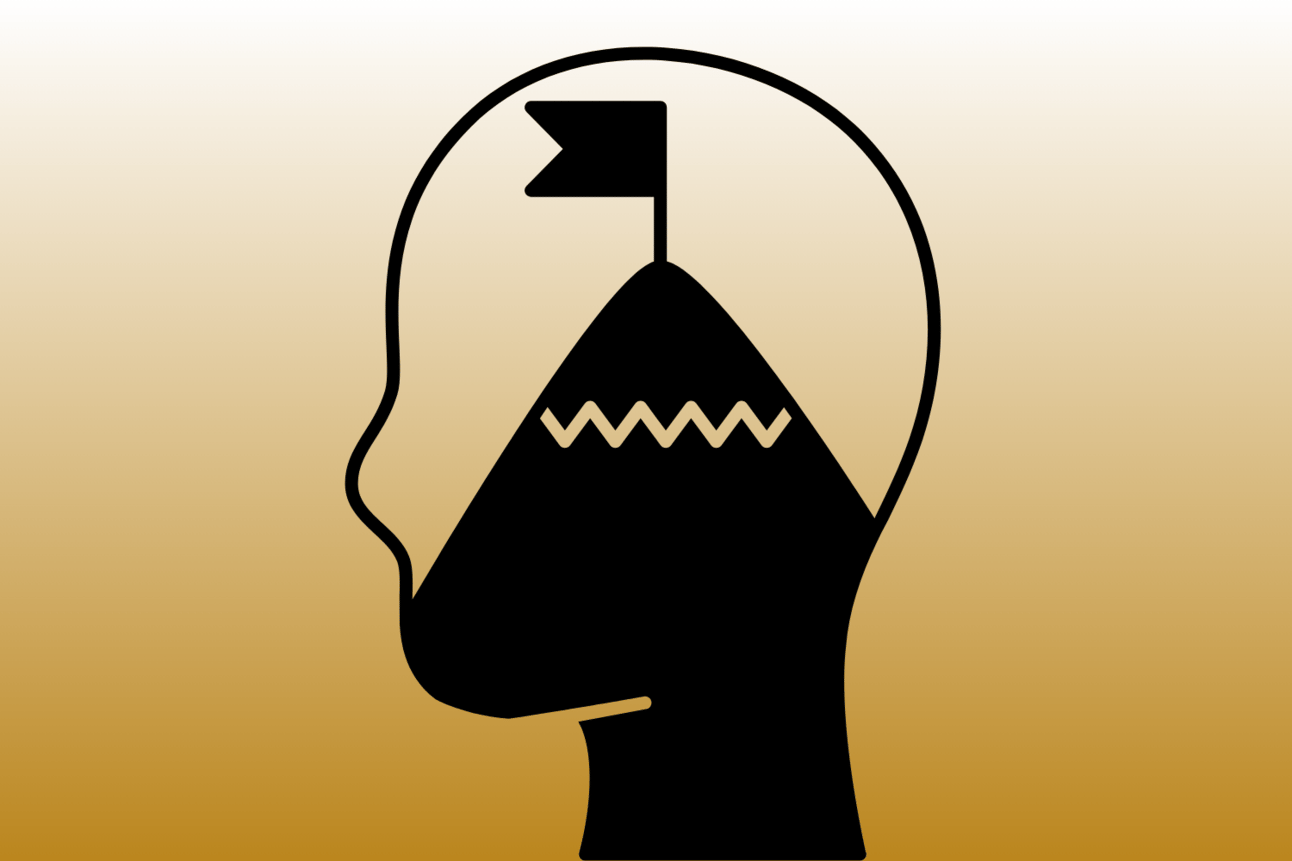
Goals are the object of our exercise of living.
To live without goals is to leave your life to chance.
-Hoping for that phone call
-Hoping for that encounter
-Hoping for an opportunity
Living purposefully entails:
Productivity
It is a necessary component to make ourselves competent (Self-efficacy). It is the act of supporting ourselves. Bringing thought into reality.
Efficacy and purpose
Our baseline competence is built on the independent competencies we build to perform individual tasks. Thus productive work is an effective self-esteem builder.
Goalsetting
Rather than assigning a goal to "get in shape" we must be direct.
Example:
- I will run for at least 30 minutes 4 times a week
- I will complete my (precisely defined) task by the end of the week
- I will earn $X in my side hustle by the end of the year
With direct goals we are able to measure progress, and if need be- readjust our course. Direct goals introduce the element of accountability.
Self-discipline
This is the ability to think, plan, and live in the long run. It requires the ability to avoid instant gratification in the effort to achieve a far-out goal. My cheesecake story was an example of self-discipline getting thrown out the window.
Enjoy the present while regarding the future and you will thrive.
Responsibility for conscious goal-setting
Are my goals vague or clearly set?
Identifying necessary action to achieve goals
Long-term goals come with prerequisite goals, realistic planning will need to be made for the entire journey.
Assessing behavior
Does my behavior align with my goals? If my goal is to be financially stable then it likely won't be appropriate to dine out every day.
Assessing outcomes of actions
Constantly checking outcomes to see if a better action can be taken. New developments related to my goals may arise, maybe I missed some details when outlining the plan.
Ogres -I mean Life Purposes are like onions

As we grow up we begin to investigate the first layer. There are our intuitions about what it is we'd like to do with our life, these help us find out what we want to do. Eventually, we peel back a layer, revealing another set of intuitions guiding us to another purpose.
Life purposes are constantly evolving, if we apply consciousness towards our desires and values.
What would you be doing if money was no issue?
If you have no purpose - I have a suggestion. Make it your purpose to find a purpose.
My Life Purposes
Throughout the past year I have been searching for my life’s meaning.
To my surprise I found 2.
To raise the quality of my consciousness (1st pillar)
To help others.
My mind is all that I have. I must develop the accuracy of my judgements and impressions of the world. This is my MEANING.
To help others is my PURPOSE, it’s one that I plan to make a career out of. After all I need to eat to. Still, I can only be proud of a career that allows me to make meaningful impact on the world.
6. The practice of personal integrity

First, integrity is defined as firm adherence to a code of moral or artistic values. To be incorruptible.
Secondly, an unimpaired condition.
Lastly, the state of being whole and undivided
The opposite of personal integrity is Opportunism.
This is hypocrisy, corruption, and the willingness to lie, cheat, steal, and manipulate. Opportunism is a cause and effect of a broken sense of self, a fragile ego, of being scared and struggling to survive.
Personal integrity is not an outward performance for social purposes. Integrity with no internal conviction is no integrity at all.
Personal integrity is how you act when no one is watching, when there is no one to impress.
When our behavior conflicts with our judgment, we lose trust in ourselves.
There is a cost to integrity. It is so much more difficult than opportunism.
The challenge of integrity is that we live in a moral swamp.
In the realm of business alone there are so many practices lacking integrity.
-Scammy sales pages
-Selling your data
-Misleading advertising
-Companies lobbying, and their predatory terms of service EULA roofying
-Higher management preaching fairness, and picking favorites
Integrity is so rare because opportunists will gain an advantage over those who practice integrity.
The creative act
Truly living creatively inherently is integral because it does not take the path of least resistance. Creating does not have to be an art, it can be something like accounting. This is the act of providing value.
Values
Personal-integrity requires we walk our talk and stand by our values, but what if our values are wrong? Or if they are blindly adopted, uncritically accepted, or if they conflict with our goals and purposes?
It is our personal-responsibility to consciously examine the origin and nature of our values. We do not lose integrity by changing our values - when done out of ultimate consideration.
By understanding the 6 pillars of self-esteem we are empowered to choose them.
The beginning of the choice will be hard. Like starting in the gym with poor physical condition, exercise is difficult. As time goes on our body strengthens and exercise becomes easier and more enjoyable.
These practices do not have to be lived at 100% to work, as long as we have the will to improve.
Obstacles of self-esteem:
Laziness
There are times of fatigue that constitute rest and there are times where our momentum is cut off by failing to generate effort.
To the people who suffer from extreme laziness, I ask:
What keeps you from putting in effort?
Is it fear of responsibility?
What effort can you make right now, that will result in meaningful progress?
Can you clean up your room, house, or apartment?
Can you start with the small things?
As for these frictional activities like washing dishes, it is important that we affirm their value for the journey. With this awareness, we can perform these tasks and appreciate the progress, no matter how small it may seem.
If you are tired of taking out the trash, think about all the times you’ve ever done it, and all the times you will take it out in the future.
You’ll likely have many of these events in your lifetime.
But you only need to take out one trash bag right now.
Fatigue
The Flow Research Collective has made new developments in neurochemistry, they reveal that accessing the "flow state" requires a specific kind of regenerative activity.
What we often describe as fatigue or mental fog is an overload in our "allostatic load". Which is the physical wear and tear on your body and mind that occurs from constantly adjusting to life’s pressures.
Without proper management, the allostatic load can build up and carry over every day. When working out, if we endlessly rep out a bicep curl, we will reach a point where we won't be able to lift our water bottle up.
When allostatic load is high our body is engaged as if we are constantly adapting to new stress. Stress hormones like cortisol and adrenaline are released in this state. In contrast, the flow state is accessed with a balance of neurotransmitters in the nervous system.
Muscles grow and strengthen in the recovery period. So too will our mind. We raise our ceiling with recovery.
Working with a high allostatic load is like trying to swim while wearing thick heavy boots.
To clear the allostatic load we need proper recovery. However "relaxation" -like watching a show or movie is not a recovering activity for the mind. It's like putting a bandaid on a bullet wound.
Active recovery works to restore balance in the nervous system.
Stressful activity engages the sympathetic nervous system. This releases fight or flight hormones: cortisol and adrealine.
Activating the parasympathetic nervous system reduces the stress response and promotes rest, digestion, and recovery. A balance between these nervous system states is a non-negotiable key to access the flow state of productivity.
Active Recovery Practices:
Breathwork:
4.7.8 and box breathing methods stimulate the parasympathetic nervous system, decrease heart rate, and enhance cognitive function.
Cold therapy:
Ideally, ice baths (cold shower are a great substitute) stimulates the production of norepinephrine. This hormone improves mood and alertness, it also triggers vasoconstriction, and vasodilation- enhancing circulation and recovery.
Heat therapy:
Sauna or hot baths
Massage:
Such as structural integration therapy, myofascial release (foam rollers and lacrosse balls rolling out muscles),
Meditation
Exercise
Hiking or walking
Sleep
There are two tests to see if the activity is working as active recovery.
First, if your heart rate variability (time between heartbeats) is increasing over the duration of your activity.
Second, if the activity gives you a substantial neurological reset, it will feel like you’ve had a mini vacation in the span of a few hours.
To those who pride themselves in their grind, consider this:
50% of our productive success is thanks to our recovery.
To optimize our two states: exertion and recovery we must oscillate rhythmically between them.
So live like a lion, rest and recover deeply, and attack your work energetically.
Avoiding discomfort
It would be more uncomfortable to sink into a recession of the six pillars than to face them head-on. The question to consider here: Will you live a life with no regrets?
The discomfort of avoiding the responsibility of life will hurt so much more than the commitment to growing.
The practices to build self-esteem may come with short-term discomfort, but the long-run benefits are greater than any material reward.
Remember: Will it start one day? Or will this be day one?
The seventh pillar of self-esteem
The six pillars all offer a choice.
No matter how loving our environment- consciousness, rationality, self-responsibility, integrity, acceptance, and purpose are never automatic.
Will, courage, determination.
These are needed.
"The energy for this commitment can only come from the love we have for our own life. This love is the beginning of virtue. It is the launching pad for our highest and noblest aspirations. It is the motive power that drives the six pillars. It is the seventh pillar of self-esteem." - Nathaniel Branden
So if you are reading this. Please. Love your life. Love your potential, love your reality, and love your self.
With this love for our lives, we can channel our emotions, desires, ambitions, goals, and every other fiber of our being to our personal growth. This work is not a race against others, but a race against yourself.
Take your life into your own hands.
On a closing note, thank you for reading this far. If you would like to start acting on your self-esteem with a low-friction practice check out the sentence completion Notion template.
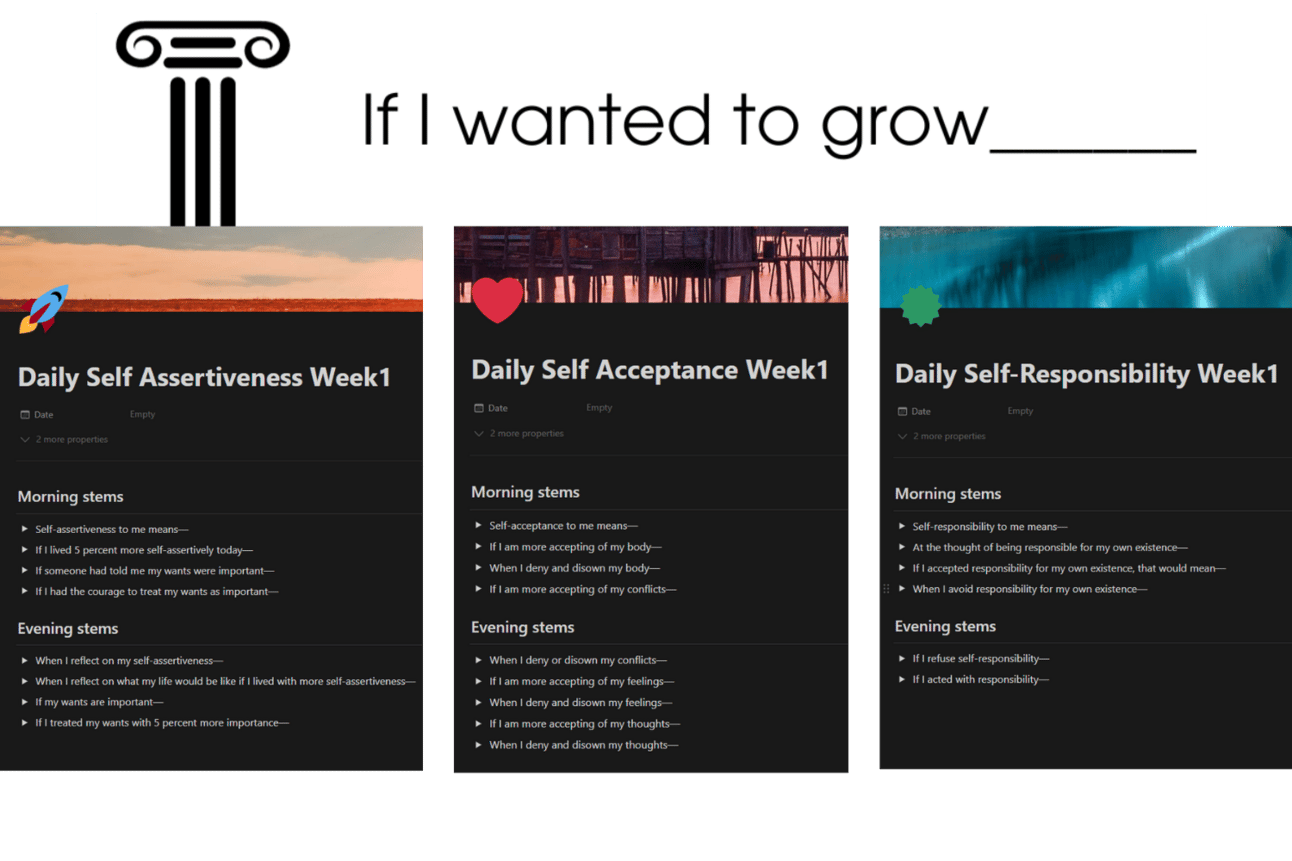
Stems provided by Nathaniel Branden’s book: The Six Pillars Of Self-Esteem: The Definitive Work on Self-Esteem by the Leading Pioneer in the Field.
I’m obsessed with music that makes me really feel something. At the end of these letters, I will share a song that embodies the energy of my topics.
I’d like to share a song with you: Change, by King Gizzard and The Lizard Wizard. This song features lyrics on living consciously.

If you think these six practices could help you - I ask that you share this letter with your friends, family, and anyone who feels lost in life. I have big plans for this newsletter, my goal is to motivate as many as I can, and to spark discussion.
Thank you.
Cheers
-Yarrow Achillea
