- The Yarrow Letter
- Posts
- How I conquered my addiction - and how you can too
How I conquered my addiction - and how you can too
Addictions stand in our path to greatness.

Yarrow Achillea
October 08, 2023
The Yarrow Letter
October 8, 2023
At least 2 billion people regularly consume alcohol.
At least 1.47 million people use marijuana.
Weed was one of the primary factors causing my chronic depression for the past few years.
I used it at first very hesitantly, I didn’t like the idea of the substance, and I was skeptical about its effects.
My friends eventually convinced me to try an edible, and I had an amazing experience.
I think most weed users can relate to the feeling of presence that it provides.
It made me feel creative, energetic, present, social, and joyous.
I used weed to get to somewhere at first.
Getting to that blissful state.
It quickly lost this positive effect on me - weed became anxiety-inducing and depressive.
My depression worsened, and I began to take weed to escape the negative feelings I didn't want to face.
I would smoke at school and at home, at any time of day, at any time I felt bad about my life.
I lived in a "Depressive Stoner Cycle":
1. I would feel bad and decide to smoke
2. Smoking would bring short-lived relief
3. I would feel worse than before
4. I feel the urge to smoke more to escape the now-intensified depression
-Having my own smoking device made this process too easy to fall into.
I have now been clean for 7 months.
This letter will describe how and why I quit weed and alcohol, and why you should too.
Warning: If you are currently using and/or enjoying these substances, this letter might make you question your lifestyle.
The root of addiction
First, we must understand the root of addiction.
It is the existential fear of nothingness.
The fear of "being".
The fear of the void.
If you cannot sit alone in an empty room without external stimulation, then you aren't yet capable of enjoying the act of "being."
For me this was especially true, my depression amplified the existential dread that I felt in times of boredom.
There was no way I would've been able to sit alone and do nothing for an hour.
Facing these fears is one way we can overcome addiction.
If we are to find peace in "being" imagine how good you'd feel while doing ANYTHING!
When we can be present in this way, we have transcended cravings.
There are a few ways we can face the fear of being:
-Do nothing
Sit in a room with no one and no external stimulation.
Truly feel what happens to you.
For the addicts, sitting like this will be torturous.
Your cravings for stimulation, love, sex, drugs, food, candy, entertainment, etc. will make you feel mentally and physically crazy.
If you can overcome the cravings then you will come closer to curbing the addiction.
Try for 1 hour.
HARD MODE:
Do nothing and ask yourself existential questions such as:
What will happen to me when I die?
Why am I here?
What am I?
Who am I?
~You might find yourself in the midst of an existential crisis if you try to take this all on at once.
Through this crisis, we can find peace.
-Meditation
I will meditate every day for the rest of my life.
Studies show just 20 minutes of meditation a day can improve:
cognitive function
subconscious creative function
focus
stress management
and it can even reduce the amount of sleep you need
This practice has helped me find presence and joy without weed:
Sit down with an upright posture for 20 minutes a day.
During this time you must attempt to notice your thoughts and let them drift away.
It's okay to have thoughts, but don't let them wrap you up in their story.
This is extremely hard at first.
"Being" is inherently empty, we must face this feeling to truly conquer addictions.
Every addict will bargain for a technique to dodge the emotional work of recovery.
This isn't possible.
How I quit alcohol.
Fear of "being" is surely one element of addiction, then there's the physical or mental condition of being addicted.
Weed and alcohol rewire our neural circuitry to depend on them more.
While life purpose, meditation, and self-esteem practices have severed my dependence on weed, the thing that helped me quit alcohol was a negative form of motivation.
That was the "nuclear meltdown hangover" combined with high awareness action.
Let me explain:
I only ever drank at parties, but that was enough to consider myself dependent on alcohol to have a good time.
Alcohol was something a poison I used to make time with people more enjoyable.
But stupid decisions, embarrassing moments, and painful hangovers were never worth it.
Then on New Year’s Eve, I had 14 shots. I weigh 160lbs, but my tolerance is rather low.
I woke up with the worst hangover of my life.
My body and head screamed at me, It was hard to even walk with the pain.
I felt like roadkill for at least a week.
With this nuclear hangover, I decided to apply immense awareness.
I brought awareness to my lack of energy, focus, and drive.
I carefully and painfully felt what my body was going through in the following days.
I brought awareness to every painful moment:
-Excruciating, forehead-splitting headaches.
-Walking around and feeling like my limbs would rather fall off.
-Feeling the burn of bile in my throat after throwing up so many times.
Bringing full awareness to the effects of alcohol brought me to an answer that felt too obvious.
I arrived at the conclusion that alcohol was not serving me.
It was not helping me. It was bad for me.
I slowed down my drinking after that - and stayed off hard alcohol.
This summer I quit alcohol for good.
Instead of trying to quit a habit or addiction with willpower and determination, try doing that activity with full awareness.
It is one thing to know that alcohol is bad for you and another thing to apply that understanding the entire time you drink.
An important part of quitting addictions.
If your addiction falls into a routine, or even if it doesn't - it's integral that you find something meaningful to replace it with.
At first, this might be the practice of being present, or meditation.
For me, it has been running and writing.
It is important to consider a plan for quitting an addiction.
Fully define why you are quitting it, and how you see your life changing afterward.
A vague approach to quitting will only result in relapse.
100% VS 99%
Imagine yourself quitting drinking - except for New Year’s Eve.
Just one day of the year, it can't hurt, right?
For the first year after setting this intention it goes well, you've mindfully set this goal and until December you keep drinking mostly out of your mind.
New Years comes and goes, and later the following year you are offered a drink at a wedding - one drink can't hurt right?
Later that week during a night out with friends they insist on bar hopping - one night of drinks can't hurt right?
This story might play out in a million different ways, the point is - 1% can grow into a relapse.
For this reason, I have decided to quit drinking and smoking for life.
Quitting for life can sound daunting of course - consider trying one day at a time.
All we have is the present. One year from now is just an idea.
All you have to do is not drink today.
Worry about tomorrow when it comes.
Remember, you don't need to drink now.
Why I'll never go back.
When I tell people that I don't drink or smoke I often get surprised comments and even concerns.
I get asked if I have a serious addiction problem.
I receive teases along the lines of:
"oooh, lil college kid can't handle the party!?"
I just don't want to drink or smoke anymore, I don't want to rely on substances to have a good time.
Our social gatherings have such a strong emphasis on under-the-influence interaction.
I am looking for a healthier way to socialize.
Weed, alcohol, and awareness.
Perception is our one tool in life, and it's not expanded or grown with these substances.
Weed and alcohol are depressants, they restrict your ability to feel.
Your ability to make sense of your:
- emotions
- surroundings
- friends (and strangers)
Even days after drinking or smoking, your engagement with life will be suppressed.
If you are frequently using substances you will grow apathetic, jaded, uninspired, unmotivated, unexcited, and fatigued.
If you frequently use, and are experiencing anxiety, depression, or any kind of despair - the source will be obscured by your dampened awareness.
If you are the type to drink most days of the week - chances are you are always drunk or hungover, so you expect to feel bad all the time.
When you reduce your drinking to once a week or less - you'll have enough clarity to see just how bad a few drinks make you feel.
Quality-of-life.
I am very grateful that I was able to get over my party phase in high school.
There are so many other things to do in life other than partying.
A proper celebration is welcome here and there, but living for the Friday night drinks is no way to live.
If I am to take control of my life, then I shall not give time, power, or energy to the substances.
Since quitting drinking and smoking my quality of life has skyrocketed.
I have more clarity and focus, my tasks are much easier to complete, and they bring a sense of progress.
I have more energy, I can even operate well on poor sleep.
I am in touch with my emotions, yet they do not bring me on a rollercoaster.
I am optimistic about my future.
I spend time of learning, resting, or having quality time with close friends instead of poisoning my body.
My wallet is a little fuller now that I don't invest in substances.
I no longer spend time with people I don't connect or resonate with.
If I need a substance to have a better time with people - are they really the type of people I should be hanging around?
The same goes for activities, try going to a party sober and you might find that you don't actually like parties.
If you have to be under the influence to enjoy the event, then you don't really enjoy the event.
Thus quitting substances will help define what your hobbies actually are.
Effect on health.
Let's start with alcohol. These negative effects occur when chronically drinking.
Chronic sounds really intense, but it’s only an average of 1-2 drinks per night.
That could be 7+ drinks on the weekend, or a few drinks just two days of the week.
Alcohol is unique in that it permeates through all cells and tissues in your body. THC on the other hand, one of the cannabinoids in weed, binds specifically to certain receptors in the brain.
Alcohol is toxic, and when your body processes it, another toxic molecule is created: acetaldehyde.
Acetaldehyde is processed into acetate, which is still toxic but used as an energy source.
As we get older our NAD levels go down, this molecule is crucial to the processing of alcohol.
If we cannot process acetaldehyde fast enough, a buildup will occur, causing even more damage.
Neurodegenerative effects:
A lasting change in neural circuitry that controls impulsive behavior - that drunk impulsivity can carry over to your sober state.
Lasting reduction in motor function.
A boost in serotonin and boosted mood while drinking, but a sharp cutoff during or after drinking.
Blackout: memory loss even if you were awake.
Higher baseline cortisol production, a long-term stress hormone - more constant stress.
Less resilience to stress.
Conversion of testosterone into estrogen - causing hormone imbalance.
Disruption of gut microbiome and gut lining.
-healthy bacteria in the gut are responsible for a healthy mood and immune system.
-leaky gut syndrome from compromised gut lining can allow bad bacteria from partially broken down food to enter the bloodstream and even the brain.
A tolerance to alcohol is developed - with a reduction boosted serotonin/mood.
Lower quality of sleep, including REM sleep.
Disrupted hydration and electrolyte levels.
The pro for wine:
The "healthy" component of wine: resveratrol is subject to debate on whether or not it actually has any health benefits.
If it is healthy, then the amount of wine you’d have to drink to benefit would be so much that you’d have far more negative health effects - defeating the purpose.
Let's talk about weed - spoiler alert: it's bad.
Cannabis contains more than 70 psychoactive molecules or cannabinoids.
The most potent of which are THC and CBD.
Our body naturally produces cannabinoid molecules, and there are associated synaptic receptors found all throughout the nervous system. brain, spine, organs, and body tissues.
Our natural cannabinoids regulate our mood, gut function, salivation, and stress response - amongst other things.
When using cannabis, whether sativa, indica, or hybrid, the THC and CBD bind to those receptors with a thousandfold more potency.
The THC/CBD outcompetes your natural cannabinoids - rendering that neurochemical system dysfunctional.
If the natural cannabinoids are like a bathtub toy boat - then THC/CBD is like the Titanic docking into your synaptic port.
Like alcohol - THC/CBD are able to permeate through cell membranes, affecting the whole body.
Cannabis use can leave us starving for a boost in mood as our natural cannabinoids are turned off - creating a constant use relationship with the substance.
Cannabis and creativity:
Creativity consists of two modes of thinking:
Divergent - where one considers many ideas, no matter how unrelated they may seem, to see what connections they can make.
Convergent - where one takes those ideas and filters out the ones that don't work, coming up with a final idea or set of ideas, thus producing something novel.
Creativity is not an event, but a process.
Divergent thinking is more probable with high levels of dopamine, but when dopamine is too high or low, it cuts off.

Convergent thinking is more probable with lower levels of dopamine.
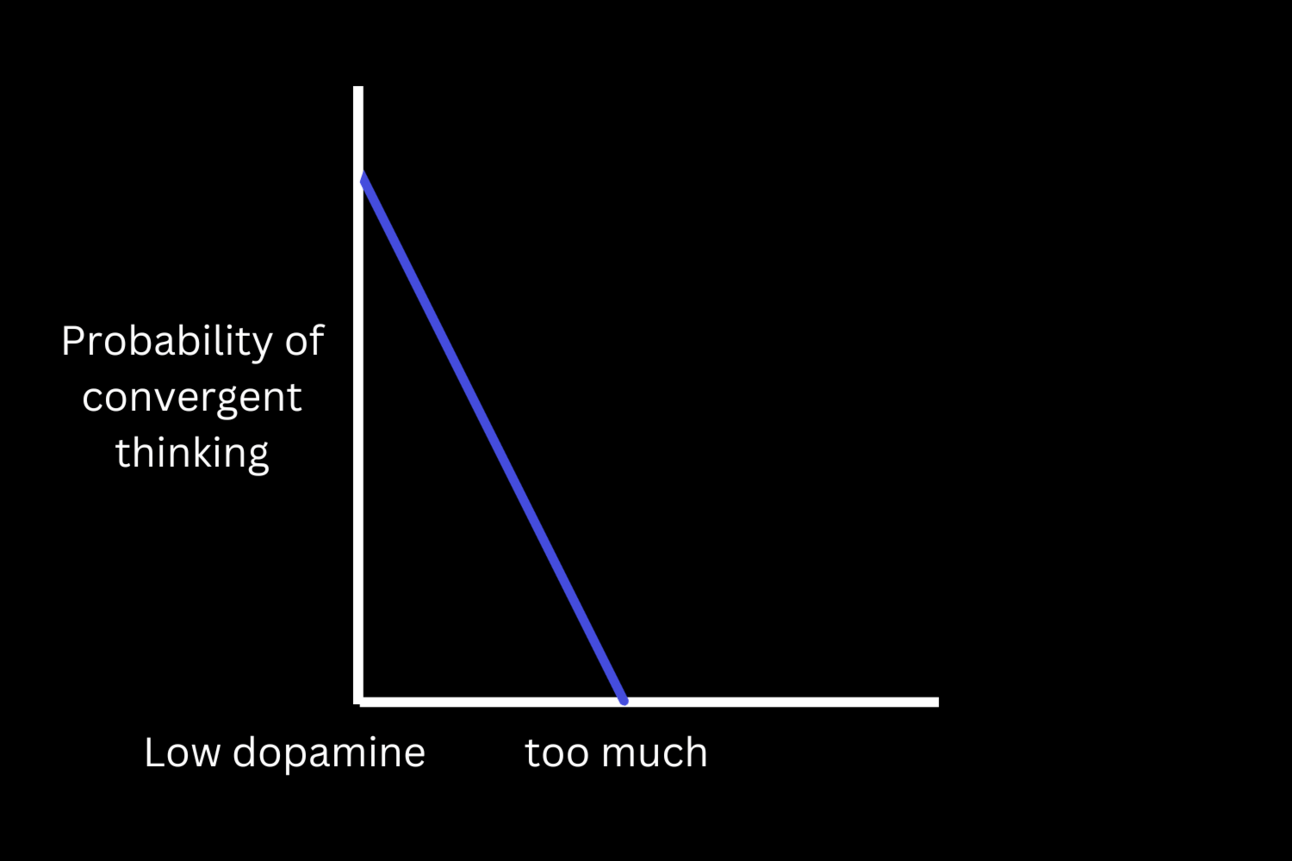
Cannabis users can see an increase in dopamine levels.
Cannabis users see increased creativity but it is an indirect influence.
Some cannabis users experience reduced anxiety while high.
Those individuals experience a more open mindset around divergent thinking, they are willing to entertain multiple seemingly unrelated ideas.
While being high may increase divergent thinking temporarily, the effects do not extend past the high.
For sober cannabis users - any increase in creativity is due to their openness to experiences.
While cannabis can reduce anxiety and elevate mood, it is common for these effects to taper off after a year of use - and in some cases, it can switch from anxiety reduction to increased anxiety
Cannabis effects on mental and bodily health.
It should be noted that vaping or smoking of any kind severely impacts lung function and increases the risk of strokes.
Cannabis use increases the likelihood of chronic depression by 4X.
It also intensifies depression with continued use.
The average age to start using cannabis is 19. Students and workers in their late teens/early twenties are twice as likely to use cannabis.
However, it is precisely this age group: under 24 that experiences the worst of cannabiss' effect on the brain.
Natural brain development sees a thickening of the grey matter (neurons) in the prefrontal cortex, with an eventual slight thinning as one matures.
Cannabis use severely, and detrimentally accelerates grey matter thinning - even with the most occasional use.
The prefrontal cortex is responsible for:
planning
controlling our emotions
reflexes
and decision making
Meaning that thinning in neurons in the prefrontal cortex can lead to reduced function in mood regulation, motor control, and general aptitude to life.
This scares me. It should scare you too. There are ways to recover some of this damage that I am currently looking into.
Let’s not encourage any further neural degeneration.
Moving on:
Chronic users (once every two weeks) under 24, have a higher chance of psychosis later in life.
Heavy users (more than twice a week) have a 4X higher chance for psychosis later in life and a 30X higher chance of getting bipolar disorder.
Even using cannabis occasionally for several years before 24 increases the likelihood of psychosis by 4X.
The more potent the THC content of the weed - the higher the chance of psychosis or major depressive/anxiety episodes later in life.
To recap - the impact of both weed and alcohol defeats the purpose of the subjective benefits - as our baseline mood and awareness are restricted.
They both come with a load of negative health impacts, from a decrease in quality sleep to compromised neural pathways.
I am not here to tell you what to do - however, I believe it is in your best interest to make informed decisions.
If you would like to hear about the effects of alcohol and weed in more depth, I would recommend these videos from Dr. Andrew Huberman:
Time for another song!
Here’s something I’ve been really enjoying lately - for its stress and anxiety-reducing effects.
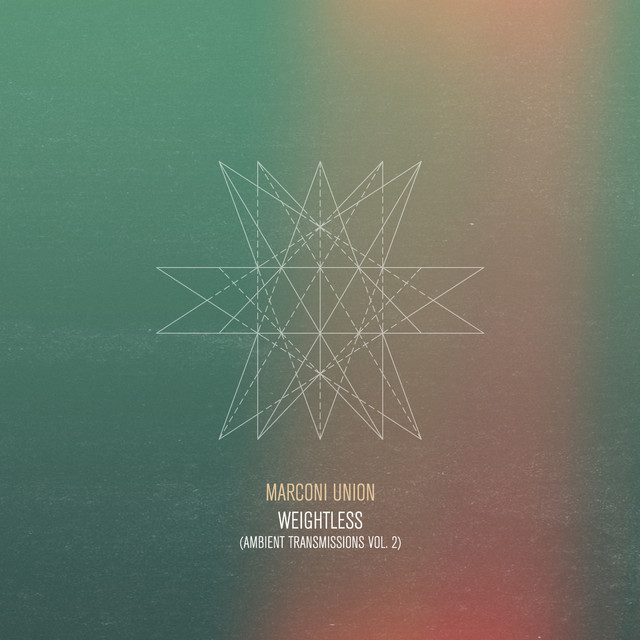
Weightless by Marconi Union was produced in collaboration with the British Academy Of Sound Therapy.
This album was produced after the initial weightless song was created.
Weightless is known to reduce stress by ~60% with just 3 minutes of listening.
~Find a time to relax and enjoy.
Improve yourself, inspire others, and change the world.
-Yarrow Achillea
